

English translation of expertise on „developing an integrated food policy and creating fair food environments“ now available
Expertise by the Scientific Advisory Board on Agricultural Policy, Food and Consumer Health Protection (WBAE) at the Federal Ministry of Food and Agriculture (BMEL) now available in English:
Executive Summary
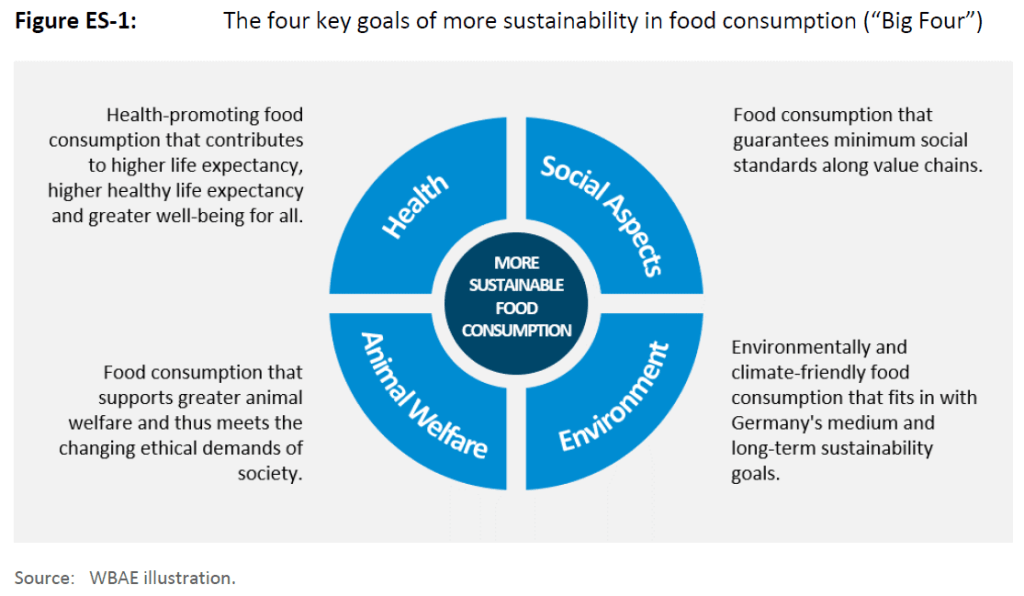
How we eat has a major impact on our individual health status, our quality of life and our well-being. Many of the foods we eat have a major social, environmental, climate and animal welfare footprint. This expertise defines policies to promote sustainability in food consumption as policies that integrate all four target dimensions: human health, social aspects, the natural environment (including climate) and animal welfare (Fig. ES-1). Achieving greater sustainability in food consumption poses great challenges. The necessary progress can only be achieved with a comprehensive transformation of today’s food system.
The question of what constitutes greater sustainability in food consumption is more difficult to answer than often assumed by the public. As consumers, we are at the same time confronted with food environments that run counter to more sustainable shopping and eating habits. In view of this, the WBAE recommends that consumers should be given much more support in achieving greater sustainability in food consumption through the design of appropriate food environments. To this end, it is first of all necessary to reduce factors in today’s prevailing food environments that hamper sustainability in food consumption (e.g. large portion sizes and high advertising expenditure on unhealthy foods). Secondly, it is important to offer food choices that are more health-promoting and have greater social, environmental and animal-welfare compatibility to make it easier to identify more sustainable options, to facilitate access to information and to set price incentives that entice consumers to opt for the more sustainable choice.
The WBAE describes such food and eating environments as fair, because and insofar as they are (1) attuned to our human perception, decision-making possibilities and behaviour; and (2) are more health-promoting and have greater social, ecological and animal-welfare compatibility and thus contribute to sustaining the livelihoods of the world’s current and future generations.
Existing conditions and environments in Germany are not very conducive to sustainability, too much responsibility is shifted to the individual and many available support instruments are not used. This expertise shows that Germany is lagging behind other European countries in this area. Emphasising the importance of appropriate food environments thus implies that a national policy for promoting sustainability in food consumption should use significantly more and deeper interventions, such as incentive taxes. In this expert opinion, the WBAE provides recommendations for a number of significant steps towards fair food environments. One main approach is to provide high-quality and free school and preschool meals.
The WBAE recommends a comprehensive reorientation and strengthening of the food policies, integrating the following four dimensions of sustainability: health, social aspects, environment and animal welfare. This requires policy to adopt a learning approach based on long-term, verifiable objectives. The necessary mix of instruments should be systematically tested, evaluated and adapted based on evidence. This necessitates stronger networking between the ministries (especially between the Ministry of Food and Agriculture, the Ministry of Health and the Ministry for the Environment) and between the various levels of government (ranging from the municipal level to EU level), as well as the scaling-up of personnel capacities with considerable budgetary increases for food and nutrition policy.
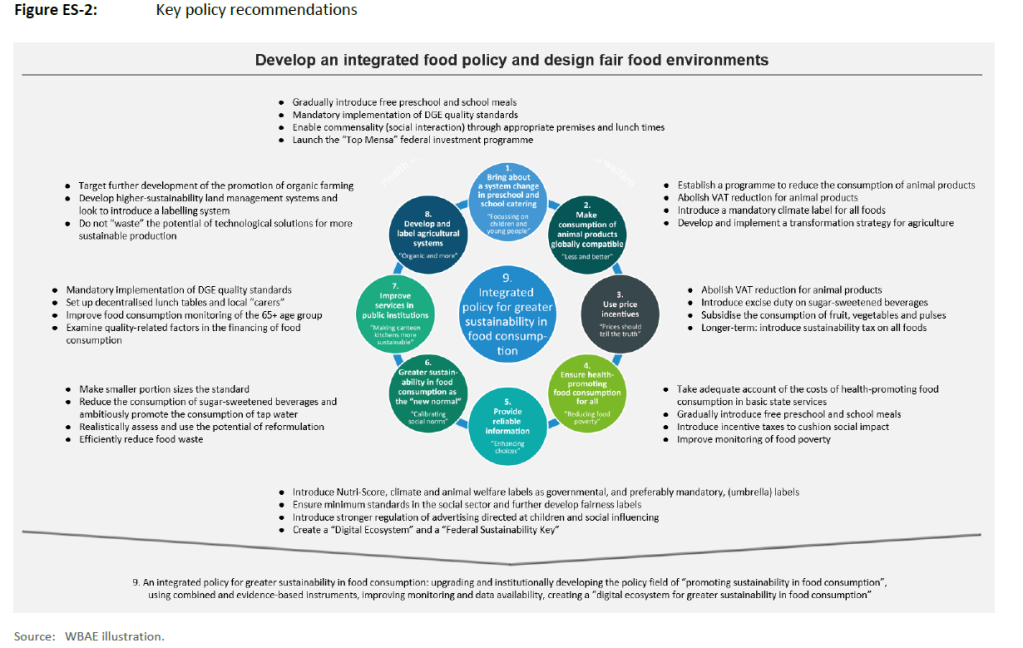
The proposed integrated food policy, with its coordinated mix of policy instruments and greater intervention intensity than hitherto (Figure ES-2: Key policy recommendations of the expertise) constitutes an important and necessary step to protect our health and environment, enhance cli-mate stewardship, mitigate food poverty, ensure compliance with minimum social standards and enhance animal welfare. Fair food environments protect and benefit all of us. Implementation of the recommended measures requires considerable additional governmental expenditure. However, in relation to the current high costs of our present food consumption for society and individuals, and the expected high (follow-up) costs in the future, this additional expenditure represents a worthwhile investment in our society as a whole. Postponing the necessary reorientation would exacerbate both the problems to be addressed and the need for adjustment. The analysis presented in this expertise shows:
A comprehensive transformation of the food system is meaningful, feasible and should begin without delay.
 Politik für eine nachhaltigere Ernährung